Invest for Jobs supports lecturers and learners in mastering project management and Scrum standards for global markets.
With support from Invest for Jobs, over 25 students completed the Agile Skills for Northern Ghana programme in Tamale. Combining project management and Scrum certification, innovation training and a hackathon, it also prepared and trained lecturers to teach the curriculum.
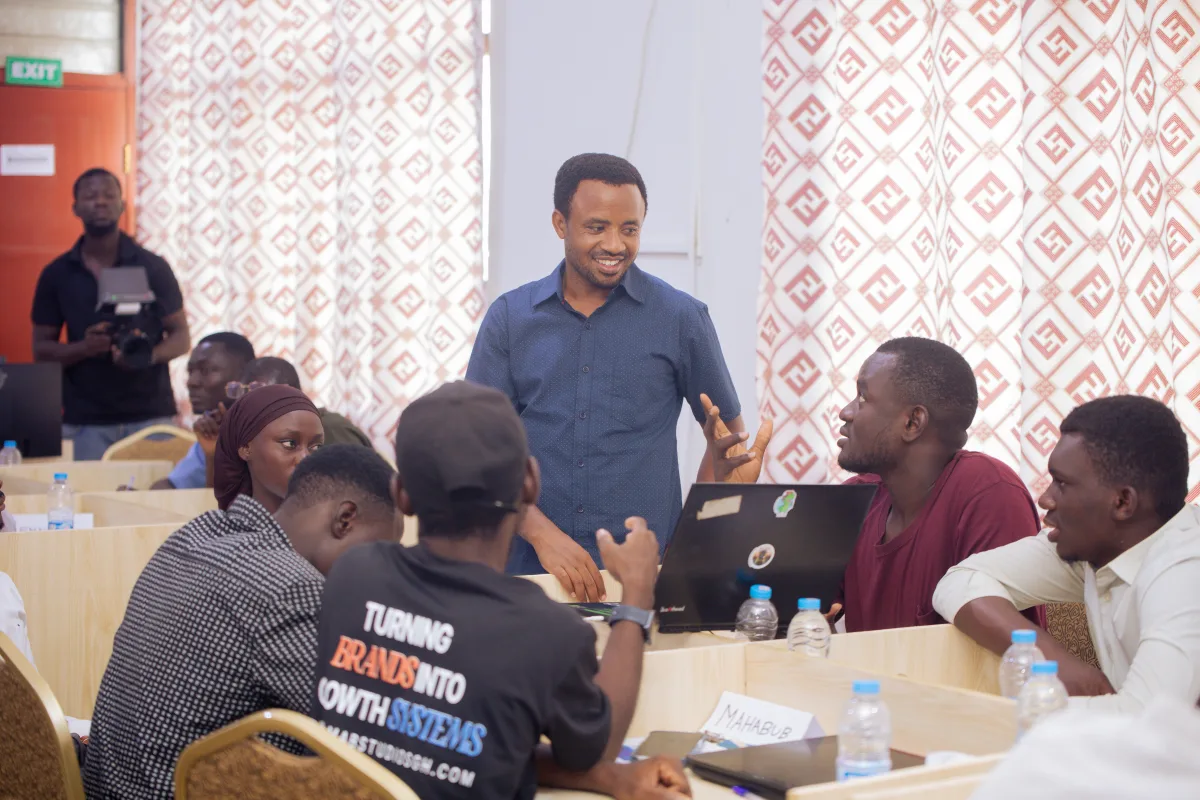
The Agile Skills for Northern Ghana programme came to an end on 3 November 2026 with final presentations and a certification ceremony at HOPin Foundation premises in Tamale. Stretching over 17 days, the initiative brought together over 25 students and lecturers to build practical, high-demand skills for the modern workforce.
The programme was delivered by Maxpert GmbH through its Africa initiative, Article26, in collaboration with UDS Business School, with support from Invest for Jobs. Maxpert is an accredited European training organisation authorised to administer global certification exams, giving young people in northern Ghana credentials that employers recognise. The programme shows how partnerships between private partners, higher education institutions and development cooperation can open up access to internationally recognised skills.
Participants worked towards two internationally recognised certifications: Project Management Associate (PMA) and Professional Scrum Master I (PSM I). The training started with four days covering the basics of project management, followed by four days on scrum roles, how to organise scrum events and the use of scrum tools, including practical scrum simulations. Additional modules covered human-centred innovation, generative artificial intelligence (AI) for agile teams and essential soft skills such as communication and time management.
 © GIZ
The programme culminated in a three-day hackathon where student teams developed solutions to a real-world German business case focused on skilled labour migration. The choice of a German case reframed the narrative on talent between Germany and West Africa, as Ghanaian students analysed a German business challenge. They presented their concepts to a judging panel, which evaluated both technical viability and business potential. Ultimately, Team Code 6 emerged the winner of the hackathon, turning the conventional discourse on talent exchange between Germany and West Africa on its head.
A key component of this initiative was the “Train the Trainer” track. Select lecturers from UDS Business School shadowed and co-facilitated sessions and will now receive eight online coaching sessions over eight weeks. This ensures they can independently deliver core modules, sustaining the training’s impact in northern Ghana after the programme concludes.
The closing ceremony was attended by key stakeholders, including Mac-Gbathy MacCarthy, CEO of the HOPIn Foundation and Dr. Ibrahim Nandom, Head of the Department at the UDS School of Business. Eric Saeed Green, Consultant for Article 26, Belinda Awumee and Chester Gadawusu, Technical Advisors at Invest for Jobs GIZ Ghana, also attended the event alongside Marc Eigen, Obed Bigirimana, and Janviere Dushimire, representing Article 26 in their capacities as Project Lead, Trainer, and Project Manager, respectively.
Reflecting on the experience, participants shared their insights:
"It doesn’t hurt to try; no expert started perfectly.
Taking the initial step is a very hard thing to do, but trust me,
if you’re brave enough to take that first step,
you are one step closer to the end
and that is the opportunity this project has created for us.”
Francis Amartey Sampah, Beneficiary
 © GIZ
The conclusion of the programme marks an important step in preparing young Ghanaians for the modern workforce, showcasing how German and Ghanaian cooperation can drive skills development and employability. As UDS lecturers take the training forward, it stands as a model for how partnerships between private partners, higher education institutions and development agencies can build a more inclusive and competitive future for northern Ghana.
Invest for Jobs – the Special Initiative “Decent Work for a Just Transition” is an initiative of the German Federal Ministry for Economic Cooperation and Development (BMZ), implemented, among others, by the Deutsche Gesellschaft für Internationale Zusammenarbeit (GIZ) GmbH.