How did Gowa El7alla come about and where did the inspiration come from?
Our journey began with the sound of a bird in Madrid, Spain. My sister Israa and I were on vacation. After a while we noticed that at every pedestrian crossing birdsong could be heard as soon as the traffic light turned green. We learned that this is an accessibility feature. A feature designed to help people with visual impairments to cross the street safely and independently.
Years after returning to Egypt, that sound stayed with us. It became a reminder that inclusion is not just about providing support but about creating independence.
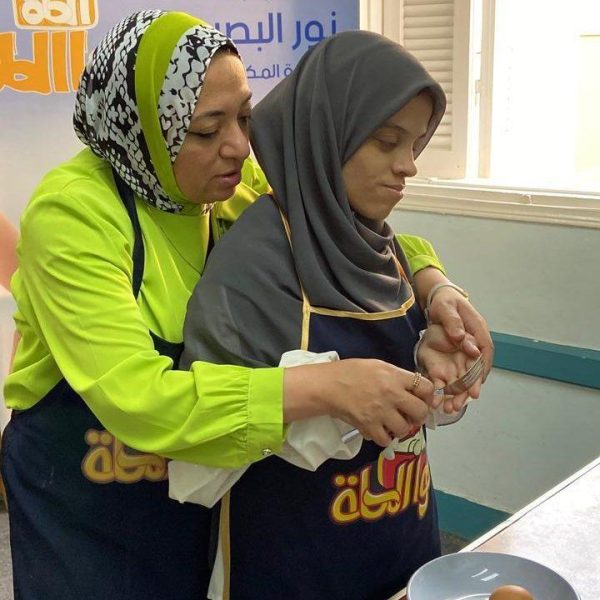
That was the moment when we decided to develop a Braille cookbook to teach cooking skills to women with visual impairments.
What led you to decide to develop a mobile app?
As we started promoting the book we discovered that around 60 per cent of visually impaired or blind people in Egypt rely on audio rather than Braille. Because many never had the opportunity to learn Braille. We also realised that Braille books have several disadvantages: They are expensive to print and bulky to carry. And with repeated use, the raised dots gradually wear down, making them difficult to read.
While starting to rethink our approach, the COVID-19 pandemic hit. Like many other companies during this difficult time, we switched to a digital solution and transformed the Braille cookbook into a mobile application, delivering our cooking lessons through audio content.
The app introduced a new methodology that we call "Four-Senses Cooking." People with visual impairments navigate the world by relying on hearing, touch, smell, and taste. We have closely integrated these four key elements by using descriptive language. That means, we use specific words and phrases to create vivid mental images and engage the senses to describe recipes and tasks.
As sighted women, how did you go about reaching out to the community and informing them about the services you offer?
During the COVID-19 pandemic, we reached our participants primarily via Facebook and WhatsApp. Specifically, through groups created and run by the visually impaired community. My sister and I initially had no direct connection to people with visual impairments but thanks to one woman, we were warmly welcomed into the groups. She is visually impaired herself and introduced us to other people affected on online networks. This really helped us to make our first contacts.
It was a remarkable experience, as it was also a new experience for the groups. Generally, sighted people are not permitted to take part in these private groups. This is understandable, as people with visual impairments are particularly vulnerable. In these groups, they find a safe space where they can talk about their everyday lives, personal challenges, their legal rights, and ways to promote greater inclusion.
We actively listened to them, built genuine relationships, and gradually earned their trust.
Nevertheless, as our initiative grew, we realised that partnerships with NGOs serving people with visual impairments were just as essential as direct contacts.
What are the main challenges you face?
As mentioned before, trust is important when, as a sighted person, you work closely with people with visual impairments. It is particularly challenging to gain the trust of families. The women themselves were excited about the opportunity to learn cooking. But their parents and caregivers were understandably cautious. For them, it was difficult to imagine how their daughters could safely attend training sessions in a home-based kitchen.
Another challenge is changing society's perception of what women with visual impairments are capable of. Many people still believe that a blind woman cannot cook safely.
Lastly, growing our business and expanding our client base is hard work. We currently offer both catering services and ready-made meals through a Business-to-Business model.
Additionally, we are trying to secure long-term contracts with companies, universities, and other institutions to create more reliability for our employees. As a start-up, building credibility and expanding our professional network remain essential steps in increasing our impact.
How many women with visual impairments could you support since launching Gowa El7alla?
To date, more than 4,000 women have benefited from the cooking courses available through our mobile application.
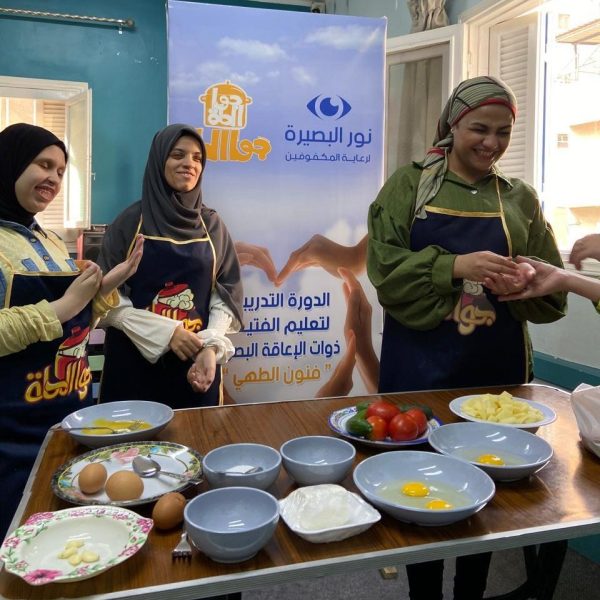
In addition, we held in-person cooking classes for 25 women. Six of them are now employed by Gowa El7alla.
Beyond our permanent staff, we also offer paid seasonal volunteer opportunities, particularly during the summer. These opportunities are open to both people with visual impairments and sighted volunteers. This mixed-team approach helps us promote inclusion, raise public awareness, and expand our capacity to train and empower more women as we continue to grow.
What are the next steps for the company?
Our next step is to expand our training programmes because we believe that more training leads directly to more employment opportunities for women with visual impairments.
Securing long-term contracts with companies and institutions is currently our highest priority. We are also preparing to collaborate with Abu Dhabi Commercial Bank to support our business growth and expansion. Once we establish a strong presence in Cairo and Giza, we plan to extend our model to other governorates across Egypt.
What advice can you offer to entrepreneurs who are committed to inclusion and skill development?
My advice to entrepreneurs is simple: listen first. Engage in meaningful, professional conversations with people with disabilities. Let them tell you about their real needs. The most impactful and sustainable innovations are born from understanding genuine challenges and co-creating solutions with the people they are meant to serve.
Gowa El7alla is supported by the Deutsche Gesellschaft für Internationale Zusammenarbeit (GIZ) GmbH within the framework of the Special Initiative "Decent Work for a Just Transition" of the German Federal Ministry for Economic Cooperation and Development (BMZ).